Skill portability, the ability of an individual to have their accumulated knowledge, competencies, and qualifications recognized and valued across different labor markets, industrial sectors, and geographic borders, has emerged as a central pillar of modern economic resilience. For Bangladesh, a nation uniquely positioned at the intersection of a massive demographic dividend and heavy reliance on both export-oriented manufacturing and overseas remittances, the seamless portability of skills is not merely an educational objective; it is a macroeconomic imperative. To transition from a low-middle-income status to a knowledge-driven developed economy, the workforce must be capable of horizontal mobility (moving across different industrial sectors) and vertical mobility (progressing to higher levels of technical and managerial expertise). The primary institutional mechanism designed to facilitate this ecosystem in Bangladesh is the Bangladesh National Qualifications Framework (BNQF). Approved in 2021, the BNQF represents a paradigm shift in how the nation defines, assesses, and certifies human capital. It serves as a unified architecture that bridges the historical divides between general education, technical and vocational education and training (TVET), and the higher education sector, aiming to make Bangladeshi qualifications transparent, globally comparable, and inherently portable.
The Current Situation: Architecture and Ambitions of the BNQF
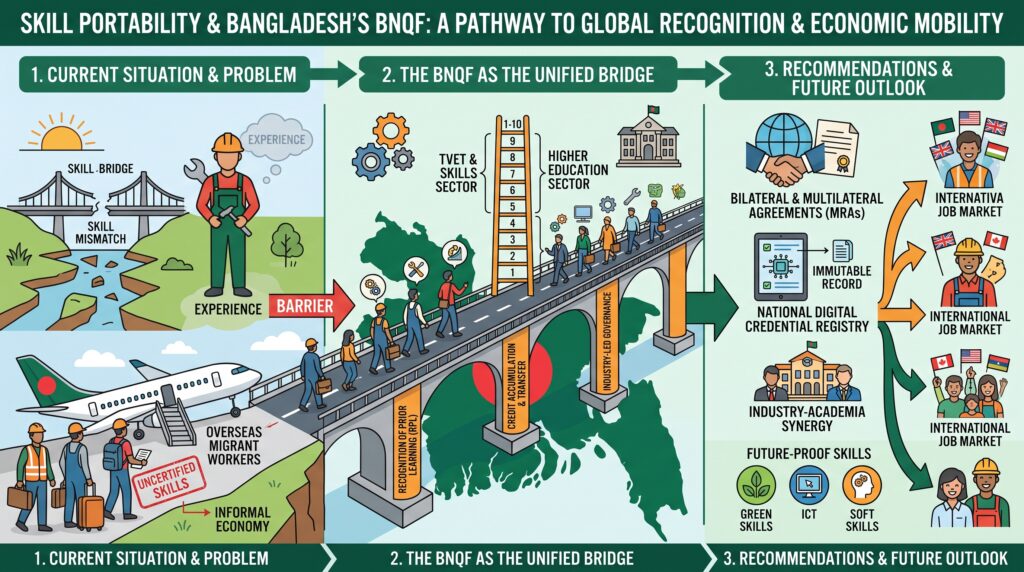
The contemporary landscape of skill development in Bangladesh is undergoing a structural transformation under the auspices of the BNQF. Prior to its implementation, the country’s educational and skill certification systems were highly fragmented. TVET operated under the National Technical and Vocational Qualifications Framework (NTVQF), while higher education and general schooling followed disparate, often disconnected, trajectories. This siloed approach created dead-ends for learners; a student completing a vocational certificate found it nearly impossible to re-enter the general higher education stream, and workers with years of informal industry experience had no mechanism to translate their practical knowledge into formal academic credits. The BNQF was formulated to dismantle these institutional barriers and establish clear, flexible pathways with multiple entry and exit points.
Structurally, the BNQF classifies all national qualifications into ten distinct levels. Levels 1 through 6 encompass the TVET and skills sub-sector, absorbing the previous National Skills Certificates (NSC), while Levels 7 through 10 govern the higher education sector, ranging from Bachelor’s degrees to doctoral qualifications. Crucially, the framework also integrates general school and Madrasah education, creating a holistic national standard. Each of these levels is defined by explicit level descriptors based on learning outcomes, clear, observable statements of what a learner knows, understands, and can do, encompassing fundamental knowledge, social skills, thinking abilities, and personal domains. By shifting the focus from input-based metrics (such as hours spent in a classroom) to outcome-based education (OBE), the BNQF ensures that qualifications reflect actual competencies rather than mere participation.
A vital component of the BNQF’s current operational strategy is the Recognition of Prior Learning (RPL) mechanism. RPL is designed to assess and certify the skills of individuals who have acquired their expertise outside formal educational institutions, such as through apprenticeships, on-the-job training in the informal economy, or generational craft knowledge. By officially mapping these informally acquired skills to specific BNQF levels, the framework provides a pathway for millions of uncertified workers in sectors like construction, light engineering, and agriculture to gain formal recognition, thereby enhancing their employability and bargaining power.
Institutionally, the governance and implementation of the BNQF require intricate coordination. The National Skills Development Authority (NSDA) plays a leading role in harmonizing the skills development activities of various ministries, while the Bangladesh Technical Education Board (BTEB) manages the assessment and certification for the TVET levels. Simultaneously, the University Grants Commission (UGC) and the Bangladesh Accreditation Council (BAC) oversee the higher education components, ensuring that universities align their curricula with the overarching framework. This collaborative governance model represents a significant step forward in creating a unified educational ecosystem.
Furthermore, the BNQF introduces a standardized credit accumulation and transfer system. This system quantifies learning hours into credits, allowing students to accumulate credits over time and transfer them between different institutions and educational tracks. For instance, a learner can complete a Level 4 diploma at a technical institute, enter the workforce, and later utilize those accumulated credits to pursue a Level 7 Bachelor’s degree at a university. This flexibility is the cornerstone of lifelong learning, allowing individuals to adapt to changing labor market demands without having to restart their educational journeys from scratch.
The Problematic Dimensions: Implementation Gaps and Portability Barriers
Despite the robust theoretical architecture of the BNQF, the realization of true skill portability in Bangladesh is hindered by deep-rooted systemic, institutional, and international challenges. The transition from policy formulation to grassroots implementation has exposed significant friction points that compromise the framework’s efficacy and the global mobility of the Bangladeshi workforce.
The Overseas Migration Paradox and “Brain Waste”
The most glaring manifestation of compromised skill portability involves Bangladesh’s overseas migrant workforce. Remittances are a lifeblood of the national economy, yet the vast majority of Bangladeshi workers migrate to the Gulf Cooperation Council (GCC) countries and Southeast Asia categorized as “unskilled” or “low-skilled” labor. This classification is often a bureaucratic fiction; many of these workers possess significant technical skills in construction, plumbing, electrical wiring, and heavy machinery operation, acquired through years of informal domestic work. However, because these skills are not formally certified, or because their domestic certifications are not recognized by destination countries, they suffer from a severe “skill discount.” They are forced to accept lower wages, poorer working conditions, and restricted upward mobility compared to similarly skilled workers from nations with internationally recognized qualification frameworks, such as the Philippines or India.
The BNQF aims to solve this, but currently, it lacks the necessary bilateral Mutual Recognition Agreements (MRAs) with primary destination countries. A BNQF Level 3 certificate holds little practical value in Saudi Arabia or Malaysia if local employers and immigration authorities do not understand its equivalence to their own national standards. This lack of international referencing means that the portability of Bangladeshi skills stops at the border, perpetuating a cycle of exploitation and unrealized economic potential.
Institutional Fragmentation and Turf Wars
Domestically, the governance of skill development remains hampered by bureaucratic fragmentation. While the BNQF is designed to be a unified framework, the actual administration of training and education is scattered across more than twenty different ministries and departments, including the Ministry of Education, the Technical and Madrasah Education Division (TMED), the Ministry of Expatriates’ Welfare and Overseas Employment, and the Ministry of Youth and Sports. This multi-headed administrative structure frequently leads to overlapping mandates, redundant training programs, and inconsistent quality assurance.
The NSDA was established to serve as the apex coordinating body, but asserting executive authority over entrenched bureaucratic silos has proven difficult. Furthermore, the cultural and institutional divide between general higher education (overseen by the UGC) and technical education (overseen by the BTEB) persists. Universities often demonstrate reluctance to grant credit transfers for TVET qualifications, viewing vocational tracks as academically inferior. This institutional snobbery directly undermines the horizontal and vertical mobility that the BNQF promises, trapping vocational learners in terminal educational pathways.
The Bottleneck in Recognition of Prior Learning (RPL)
While RPL is theoretically the most transformative element of the BNQF for Bangladesh’s massive informal sector, which constitutes over 80% of the total workforce, its practical implementation has been painfully slow and scale-limited. The current RPL assessment processes are often overly bureaucratic, requiring workers to take time away from their livelihoods to visit formal testing centers. Assessors frequently employ rigid, written-test methodologies that are entirely unsuited for evaluating practical, tacit knowledge, disproportionately penalizing workers with low traditional literacy but high technical competence.
Additionally, there is a severe shortage of certified industry assessors capable of accurately mapping workplace skills to BNQF standards. Without a massive scaling of decentralized, workplace-based RPL mechanisms, millions of highly capable artisans, mechanics, and technicians remain locked out of the formal economy, unable to leverage their skills for better financing, formal employment, or international migration.
The Industry-Academia Disconnect and Outdated Curricula
Skill portability relies heavily on the currency and relevance of the skills being certified. In Bangladesh, there is a pervasive disconnect between the competencies produced by training institutions and the immediate demands of the labor market. Many TVET institutes and universities continue to rely on outdated curricula, obsolete machinery, and instructors who lack recent industrial experience. Consequently, graduates enter the workforce holding BNQF-aligned certificates but lacking the practical capabilities required by modern employers.
This problem is exacerbated by the rapid pace of technological change. As global supply chains digitize and the imperative for sustainable development grows, there is an escalating demand for proficiency in green skills, data analysis, automation, and basic Information and Communication Technology (ICT). A worker whose skills are highly specialized in legacy manufacturing processes will find their skills rapidly depreciating in portability as industries automate. The current training ecosystem is too sluggish to dynamically update level descriptors and curricula to reflect these emergent economic realities, rendering the workforce vulnerable to structural unemployment.
Quality Assurance and the Trust Deficit
Ultimately, a qualifications framework is a currency of trust. Employers must trust that a BNQF Level 4 certificate holder universally possesses the competencies described in the framework, regardless of which institution issued the credential. Currently, Bangladesh struggles with a profound quality assurance deficit. The proliferation of private training providers and the lack of rigorous monitoring mechanisms mean that the quality of instruction and assessment varies wildly. When employers encounter graduates who hold certificates but cannot perform the associated tasks, trust in the entire framework erodes. This trust deficit destroys domestic skill portability; if an employer in Dhaka does not trust a certificate issued in Rajshahi, the worker’s mobility is severely restricted.
Strategic Recommendations: Operationalizing True Portability
To transition the BNQF from a well-designed policy document to a functional engine of economic mobility, Bangladesh must implement a series of aggressive, coordinated interventions across international diplomacy, institutional governance, pedagogical reform, and technological integration. The focus must shift from merely issuing qualifications to guaranteeing their universal currency and portability.
Forging Bilateral and Multilateral Mutual Recognition Agreements (MRAs)
The immediate priority for enhancing international skill portability is the aggressive pursuit of MRAs with key labor destination countries. The Ministry of Foreign Affairs, in tandem with the Ministry of Expatriates’ Welfare and Overseas Employment and the NSDA, must launch targeted diplomatic initiatives to reference the BNQF against the National Qualifications Frameworks (NQFs) of countries like Saudi Arabia, the UAE, Qatar, Malaysia, and Singapore.
This involves collaborative mapping exercises where technical experts from both nations align their level descriptors, ensuring that a BNQF Level 3 is formally recognized as equivalent to the corresponding level in the host country. Furthermore, Bangladesh should actively participate in regional referencing frameworks, such as the ASEAN Qualifications Reference Framework (AQRF), to facilitate broader regional mobility. To build trust with destination countries, Bangladesh could invite foreign assessment bodies to co-certify workers prior to deployment, transforming the migration model from exporting “cheap labor” to exporting “certified technical professionals,” thereby significantly increasing per-capita remittance inflows.
Decentralizing and Digitizing the RPL Ecosystem
To address the bottleneck in certifying the informal workforce, the RPL system must undergo radical decentralization and digitization. Assessment must be brought directly to the worker, rather than forcing the worker to the assessment center. The NSDA should empower mobile assessment units and utilize digital evidence portfolios. For example, a master mason or a heavy equipment operator could be assessed via video submissions of their work, verified by localized industry experts, rather than sitting for a written exam.
Furthermore, the financial burden of RPL assessment must be eliminated for the worker. The government, potentially utilizing funds from the Wage Earners’ Welfare Board or international development partners, should fully subsidize RPL certification for workers in strategic sectors. By integrating RPL assessments directly into major infrastructure projects, allowing workers to be assessed and certified on the job while building national highways or power plants, Bangladesh can rapidly scale the certification of its informal sector, granting them the domestic and international portability they currently lack.
Empowering Industry-Led Governance and Sector Skills Councils
To close the gap between training and industry needs, the governance of skill development must decisively shift from a supply-driven model to a demand-driven one. The existing Sector Skills Councils (SSCs), which represent specific industries like RMG, light engineering, IT, and agro-processing, must be granted executive authority over curriculum design and assessment standards, rather than functioning merely as advisory bodies.
Industry representatives must dictate the competencies required at each BNQF level. Furthermore, Bangladesh should heavily incentivize dual-training systems and modern apprenticeships, where a significant portion of a student’s learning occurs on the factory floor or in the corporate office, co-financed by the private sector. When industry is intrinsically involved in the training and assessment process, the resulting qualifications are automatically trusted and inherently portable across that sector.
Future-Proofing Curricula: Green Skills, ICT, and Soft Skills
To ensure long-term portability, the BNQF descriptors and underlying curricula must be dynamically updated to reflect the future of work. The transition toward automated manufacturing, artificial intelligence, and climate-resilient infrastructure means that narrow, task-specific vocational training is no longer sufficient.
Every level of the BNQF, from pre-vocational to higher education, must integrate foundational modules in digital literacy, data management, and basic programming. Simultaneously, green skills must be mainstreamed. A certified electrician must be trained in solar grid integration; an automotive mechanic must be transitioned toward electric vehicle (EV) maintenance. Moreover, soft skills, such as critical thinking, complex problem solving, cross-cultural communication, and teamwork, must be formally assessed and embedded into the curriculum. Technical skills may become obsolete with new technology, but these cognitive and interpersonal abilities provide the ultimate horizontal portability, allowing workers to continuously learn and pivot across entirely different industries throughout their careers.
Establishing a National Digital Credential Infrastructure
In an era of globalized labor markets, paper certificates are highly susceptible to fraud, loss, and verification delays, severely impeding rapid skill portability. Bangladesh must develop a centralized, blockchain-backed National Digital Credential Registry. Every qualification issued under the BNQF, alongside every RPL certification and micro-credential, should be logged on this immutable ledger.
This infrastructure would allow a prospective employer in Dubai or Singapore to instantly verify a Bangladeshi worker’s credentials via a secure QR code or digital portal, completely eliminating the delays and costs associated with third-party background checks and embassy attestations. Furthermore, this digital architecture enables the issuance of “micro-credentials”, certifications for short, targeted bursts of learning (e.g., a two-week module on operating a specific new CNC machine). Micro-credentials allow workers to continuously stack skills and update their profiles without committing to multi-year degree programs, providing agile, real-time portability in a fast-paced economy.
Strengthening Quality Assurance and Harmonization
Finally, the integrity of the BNQF rests entirely on rigorous Quality Assurance (QA). The NSDA and BAC must transition from sporadic, compliance-based inspections to continuous, supportive capacity building for training institutions. This requires heavy investment in “training the trainers”, ensuring that instructors and assessors have recent, relevant industry experience and are deeply familiar with OBE methodologies.
Simultaneously, the government must mandate and enforce genuine academic parity between the technical and general education streams. The UGC and university syndicates must be required to establish clear, transparent credit-transfer matrices that honor BNQF-aligned TVET diplomas. Until a vocational graduate can seamlessly transfer their credits to an engineering or business degree program at a major public university, the promise of vertical portability remains unfulfilled.
The successful operationalization of the Bangladesh National Qualifications Framework is not a mere administrative exercise; it is the definitive economic battleground for the nation’s future. By dismantling institutional silos, aggressively pursuing international recognition, integrating future-oriented competencies, and decentralizing the certification of informal skills, Bangladesh can transform its vast human capital into a highly mobile, globally competitive workforce. Skill portability is the mechanism through which the demographic dividend is realized, ensuring that every citizen’s capability is recognized, valued, and utilized, regardless of where they learned it or where they choose to apply it.