
Introduction and Purpose
This comprehensive framework establishes a structured integration model for Artificial Intelligence (AI) across Technical and Vocational Education and Training (TVET) sectors, perfectly aligned with the 8 levels of the Bangladesh National Qualifications Framework (BNQF). It bridges national occupational standards, competency-based training and assessment (CBT&A), and emerging AI-driven workforce requirements.
BNQF Level-by-Level AI Competency Architecture
The framework scales knowledge, ethical responsibility, and technical capability incrementally from foundational digital awareness to advanced systemic innovation across all eight BNQF levels:
| BNQF Level | Qualification Tier / Equivalent | AI Competency Focus & Scope | Expected Learner / Trainee Profile |
| Level 1 & 2 | Basic Certificate / National Certificate I & II | Foundational AI Literacy & Safe Use: Recognizing basic AI tools, applying ethical prompt guidance, understanding personal data protection, and utilizing AI under direct supervision for learning or basic tasks. | Entry-level trainees, basic trade learners, school-to-work transition cohorts. |
| Level 3 & 4 | National Certificate III & IV (CBT&A Aligned) | Applied Trade Integration: Operating trade-specific AI software, digital diagnostic assistants, automated maintenance logs, and virtual/extended reality (VR/AR) simulators while verifying outputs against manual standards. | Skilled craftspeople, certified technicians, mid-level operators in manufacturing, ICT support, and services. |
| Level 5 | Diploma / Associate Degree | Tactical Workflow Optimization: Managing localized data collection, utilizing AI-driven quality assurance systems, interpreting predictive maintenance metrics, and troubleshooting operational blockages. | Assistant engineers, vocational supervisors, advanced technical diploma holders. |
| Level 6 | Bachelor’s Degree | System Adaptation & Process Integration: Designing AI-assisted workflows, conducting algorithmic bias assessments, deploying sector-specific machine learning models, and leading institutional digital transformation. | Professional technologists, engineers, senior vocational trainers, curriculum developers. |
| Level 7 | Master’s Degree | Strategic Governance & Applied Research: Formulating enterprise or institutional AI policies, managing complex data pipelines, conducting ethical impact assessments, and directing applied sector research. | Senior technical experts, industrial R&D leaders, master trainers, policy planners. |
| Level 8 | Doctoral Degree | Advanced Architecture & System Innovation: Inventing and engineering proprietary AI models, defining national occupational qualification standards for AI, and directing systemic national TVET reforms. | Senior researchers, national qualification framework specialists, academic policy advisors. |
Core Operational Pillars of the Framework
1. Curriculum Redesign and Modular Credentialing
- Stackable Micro-Credentials: Because AI technologies evolve faster than traditional curriculum revision cycles, institutions will incorporate modular, stackable short courses addressing specific AI skills.
- Contextualized Trade Integration: AI modules are embedded directly into existing trades (e.g., AI-assisted automotive diagnostics, smart construction BIM tools, precision agriculture data analytics) rather than taught in isolated computer labs.
2. Pedagogical Progression (The 4-Level Repertoire)
Training delivery follows a structured pedagogical progression to prevent skill atrophy and ensure human-centred mastery:
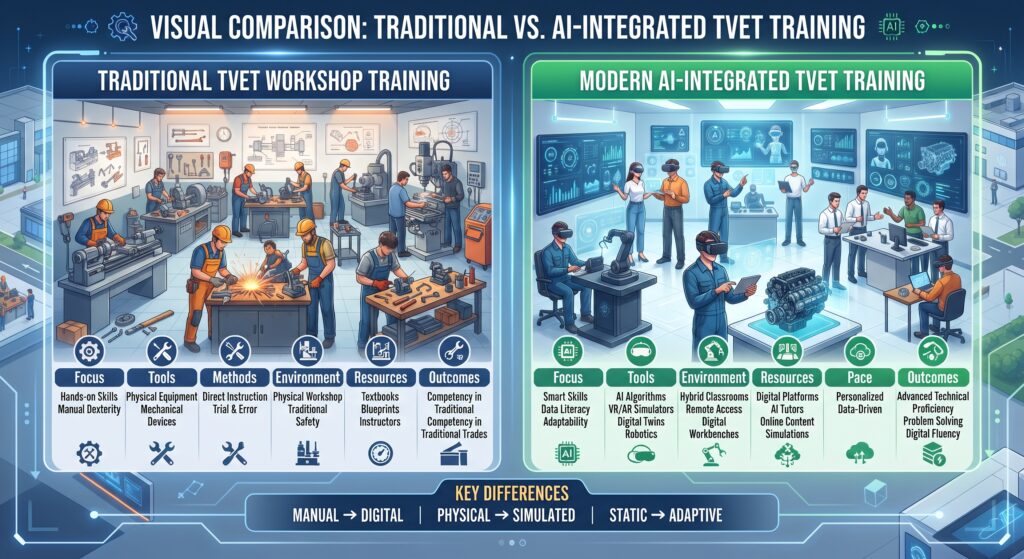
- AI-Independent Learning: Foundational psychomotor skills, manual dexterity, and safety procedures must be mastered without digital aids.
- AI-Aware Learning: Critical discussions examining how AI shifts occupational task profiles and where human judgment remains irreplaceable.
- AI-Supported / Enhanced Learning: Using intelligent tutoring systems, adaptive learning platforms, and simulated work environments to accelerate procedural learning.
- AI-Centric Learning: Investigating the underlying data, model architecture, and ethical boundaries of AI systems.
3. Assessment Integrity and Verification
To maintain the credibility of BNQF-aligned certifications in the generative AI era, assessment methodologies are categorized and safeguarded:
- Al-Excluded Assessments: Used for safety-critical and foundational competencies requiring direct physical observation, live practical demonstrations, and oral validations.
- Al-Permitted / Integrated Assessments: Structured tasks where AI use must be fully disclosed via process logs, reflective journals, and oral defenses to prove individual comprehension.
- Human-in-the-Loop Summative Decisions: Final grading, progression, and certification authority remain exclusively with qualified human assessors.
Implementation Guidelines for TVET Institutions in Bangladesh
- Establish Institutional AI Governance Committees: Form multidisciplinary oversight bodies comprising institutional leadership, industry representatives, and trainers to evaluate tools for bias, data security, and pedagogical value.
- Infrastructure & Equity Strategies: Prioritize low-bandwidth and offline-compatible AI tools, mobile-first learning solutions, and structured digital inclusion plans to bridge disparities across rural and urban training facilities.
- Continuous Professional Development (CPD): Implement stepped capacity-building programs for TVET master trainers and instructors, utilizing frameworks adapted from international standards to transition teachers into facilitators of critical thinking.
- Industry Collaboration: Partner with national sector skills councils (SSCs) and employers to continuously realign qualification standards with actual workplace AI adoption rates, ensuring local economic relevance.