
The socio-economic trajectory of Bangladesh over the past five decades represents one of the most remarkable development narratives in South Asia. Transitioning from a war-ravaged agrarian economy in 1971 to achieving lower-middle-income status, the country has maintained sustained gross domestic product growth driven largely by export-oriented ready-made garments (RMG), overseas remittances, and agricultural productivity. However, as Bangladesh approaches its formal graduation from the United Nations’ Least Developed Country (LDC) category, the traditional economic model premised on low-skilled, low-wage labor faces profound structural headwinds. The erosion of preferential tariff regimes, the rapid advent of the Fourth Industrial Revolution (4IR), automation across manufacturing shop floors, and climate-induced economic displacement collectively necessitate an urgent transition toward a higher-productivity, knowledge-intensive, and skill-driven economy.
Within this macroeconomic shift, Technical and Vocational Education and Training (TVET) has been positioned by national development planners as a primary instrument for human capital development, youth employability, and equitable wealth distribution. Bangladesh possesses a pronounced demographic dividend, with over 60 percent of its population currently within the working-age bracket of 15 to 64 years. Approximately two million young people enter the labor market annually, creating unprecedented pressure on the state and the private sector to generate productive, decent employment opportunities. Despite this demographic endowment, the nation contends with severe labor market imbalances characterized by pervasive youth underemployment, widespread educational mismatches, and an overwhelming concentration of workers,exceeding 85 percent, in the informal economy, where productivity and wages remain low.
The vulnerability of the demographic dividend is particularly stark among young women and socially marginalized populations. National labor force statistics demonstrate a persistent gender disparity in economic participation. While male labor force participation consistently hovers above 80 percent, female labor force participation (FLFP) has fluctuated between 36 and 42 percent over the past decade, remaining heavily concentrated in low-tier garment manufacturing, subsistence agriculture, and unpaid domestic labor. Furthermore, diagnostic assessments conducted under the Economic Acceleration and Resilience for NEET Project (EARN) reveal that approximately 27 percent of youth aged 15 to 29 in Bangladesh are Not in Education, Employment, or Training (NEET), a phenomenon that is overwhelmingly gendered, with women constituting nearly 90 percent of all NEET youth.
Historically, TVET in Bangladesh has occupied a subordinate status within the broader national education architecture. The societal preference for general academic degrees has generated an entrenched cultural perception of vocational education as a second-tier fallback for academic underachievers or economically disadvantaged youth. This social stigma has disproportionately affected women and marginalized cohorts. For women, vocational training has historically been viewed through the prism of traditional domesticity, limiting their exposure to high-demand technical trades. For persons with disabilities (PWDs), ethnic minorities, transgender individuals (Hijra), and ultra-poor rural communities, vocational institutions have long remained physically, socially, and economically inaccessible. Consequently, mainstreaming Gender Equality and Social Inclusion (GESI) into TVET is not merely a social justice imperative; it is a fundamental macroeconomic necessity for sustaining national growth, fostering inclusive industrialization, and avoiding the middle-income trap.
Conceptualizing Gender Equality and Social Inclusion (GESI) in TVET
The discourse surrounding Gender Equality and Social Inclusion within technical and vocational education has evolved from a narrow focus on numerical headcount parity to a holistic, rights-based, and transformative framework. In the context of TVET, gender equality entails not only ensuring equal access for women and men to training opportunities, but also dismantling the systemic, pedagogical, cultural, and labor market barriers that dictate what skills individuals acquire, under what conditions they learn, and how their qualifications translate into post-graduation economic empowerment. Social inclusion expands this analytical lens to encompass individuals and groups who face multidimensional exclusion rooted in disability, ethnicity, geographic displacement, socioeconomic status, religion, and gender identity.
A rigorous conceptualization of GESI in the skills development ecosystem requires recognizing the phenomenon of intersectionality. Vulnerability is rarely unidimensional. A young woman living with a physical disability in an isolated char (riverine island) faces compounded, multiplicative barriers compared to an urban, able-bodied male or even an urban, able-bodied female. Similarly, indigenous women in the Chittagong Hill Tracts (CHT) or plainland ethnic minority communities encounter combined linguistic, geographical, economic, and cultural hurdles that systematically insulate them from centralized technical education institutions. The ILO Assessment of Gender Equality and Social Inclusion Gaps in the Skills and TVET Sector of Bangladesh highlights that without an explicit intersectional framework, standard inclusion policies often inadvertently benefit only the most accessible subsets of marginalized groups, such as urban middle-class women, while leaving deeply disenfranchised populations behind.
From an economic perspective, exclusion generates severe allocative inefficiencies. When women and marginalized communities are structurally barred from technical and STEM-oriented (Science, Technology, Engineering, and Mathematics) occupations, the national economy forfeits a vast pool of potential talent, depressing industrial productivity and innovation. Furthermore, occupational segregation perpetuates intergenerational poverty cycles: women concentrated in low-skill, low-productivity trades earn depressed wages, which in turn diminishes household investments in healthcare, child nutrition, and education. Conversely, embedding transformative GESI principles into TVET enhances household resilience, boosts industrial diversification, and accelerates the achievement of Sustainable Development Goals (SDG 4 on quality education, SDG 5 on gender equality, SDG 8 on decent work, and SDG 10 on reduced inequalities).
National Policy and Institutional Architecture for GESI
The policy architecture governing technical and vocational education in Bangladesh has progressively recognized the significance of inclusion over the past two decades, shifting from generic commitments to targeted institutional directives. The foundation of modern vocational reform was laid by the National Skills Development Policy (NSDP) 2011, which formally recognized skills development as an essential driver of national competitiveness. The NSDP 2011 established an explicit target of achieving a 20 percent female enrollment quota in technical and vocational institutions, alongside a 5 percent reservation for persons with disabilities. The policy also mandated the development of flexible learning pathways, the expansion of the National Technical and Vocational Qualifications Framework (NTVQF), and the formalization of the Recognition of Prior Learning (RPL) to integrate informal workers, many of whom are women and underprivileged youth, into the certified labor market.
Subsequent policy revisions, including the updated National Skills Development Policy 2021 and operational directives formulated under the National Skills Development Authority (NSDA) Act 2018, have attempted to deepen these commitments. The NSDA, functioning under the Prime Minister’s Office, was instituted to serve as the apex regulatory and coordinating body, harmonizing skills initiatives across 23 separate line ministries that operate vocational training programs. Concurrently, the Directorate of Technical Education (DTE) under the Technical and Madrasah Education Division (TMED) of the Ministry of Education oversees the formal public TVET network, while the Bangladesh Technical Education Board (BTEB) serves as the statutory quality assurance and curriculum accreditation agency.
| Policy / Regulatory Framework | Governing Body | Primary GESI Provisions | Implementation Realities and Bottlenecks |
| National Skills Development Policy (NSDP 2011 / 2021 Draft) | NSDA / TMED | 20% female enrollment quota; 5% disability quota; expansion of Recognition of Prior Learning (RPL). | Female quota underutilized in engineering trades; disability quota rarely enforced due to physical accessibility barriers. |
| National Technical and Vocational Qualifications Framework (NTVQF) | BTEB / NSDA | Competency-based training and assessment (CBT&A); standardized modular certification across levels 1–6. | Modular entry helps non-formal learners, but lack of assistive learning tools limits access for persons with disabilities. |
| National Skills Development Authority Act 2018 | NSDA (PMO) | Apex coordination across 23 ministries; industry-led skills governance; inclusive workforce registration. | Fragmentation across ministries persists; monitoring mechanisms lack sex- and disability-disaggregated tracking. |
| Technical and Madrasah Education Division Strategic Plans | DTE / TMED | Infrastructure modernization; establishment of dedicated female polytechnics; stipend distribution. | Dedicated female institutes remain confined to divisional hubs, reinforcing urban-rural educational divides. |
| Rights and Protection of Persons with Disabilities Act 2013 | Ministry of Social Welfare / Inter-Ministerial | Mandatory reasonable accommodation in public education and vocational centers; anti-discrimination mandates. | Weak enforcement mechanisms; vocational trainers lack specialized pedagogical training for sensory and cognitive impairments. |
Despite this robust body of statutory commitments, a substantial implementation gap persists between de jure policy mandates and de facto institutional realities. Public vocational institutions frequently operate without dedicated gender focal points or trained personnel equipped to enforce GESI directives. The 20 percent female quota and 5 percent disability quota are often treated as aspirational benchmarks rather than legally enforceable enrollment standards. Monitoring and evaluation mechanisms across the DTE and BTEB remain predominantly input-driven, measuring physical infrastructure and aggregate student counts while failing to collect and analyze granular, disaggregated data regarding trade-level attrition, examination success rates, and post-graduation labor market transitions for marginalized demographics.
Furthermore, institutional fragmentation across the 23 ministries conducting skills development leads to duplication, contradictory standards, and highly uneven resource allocation. While donor-supported projects implemented by development agencies such as the International Labour Organization (ILO), GIZ, the World Bank, and the Asian Development Bank (ADB) have piloted successful GESI mainstreaming models, these interventions frequently remain isolated pilot initiatives. Institutionalizing these practices into permanent recurrent budget allocations of the national government remains one of the central governance challenges of the skills sector.
Empirical Landscape of TVET Participation Across Marginalized Demographics
A rigorous examination of vocational education in Bangladesh requires disaggregating empirical data across educational tiers, geographic locations, and demographic segments. The formal TVET delivery system comprises three primary streams: secondary-level vocational programs (SSC Vocational, spanning grades 9 and 10), higher secondary vocational programs (HSC Vocational and HSC Business Management, spanning grades 11 and 12), and tertiary-level 4-year Diploma in Engineering programs administered primarily by public and private Polytechnic Institutes.
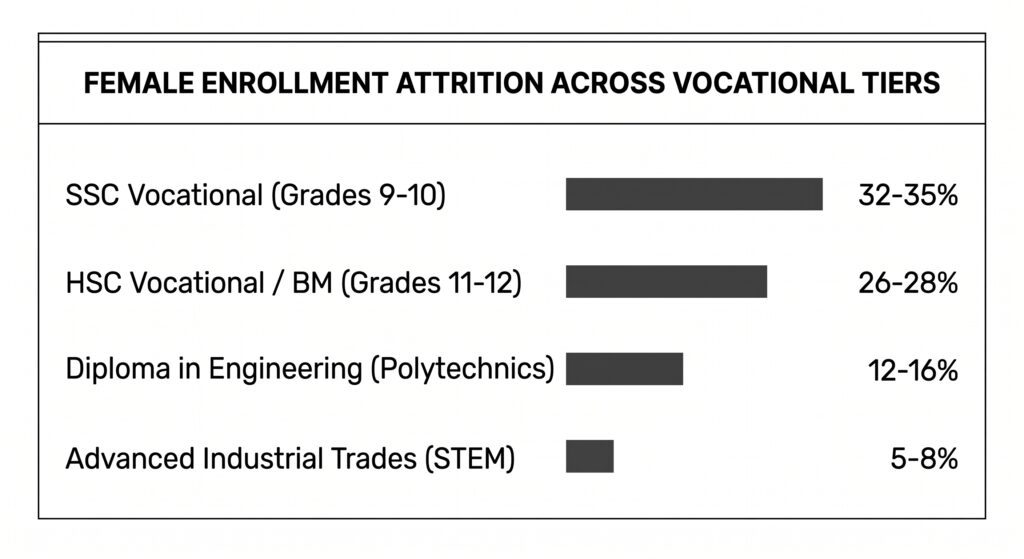
According to sector performance reviews and statistical evaluations published in the TVET Annual Sector Performance Report and historical analysis by the World Bank on Female Participation in TVET, aggregate female enrollment in formal TVET has expanded from under 10 percent in the early 2000s to approximately 20 to 27 percent across all vocational streams. However, this macro-level figure masks pronounced internal disparities across qualification levels and disciplines.
In secondary-level vocational schools (SSC Voc), female participation often approaches 30 to 35 percent, largely bolstered by secondary school stipend programs that incentivize female retention. However, as students progress to tertiary technical diplomas, the primary qualification for mid-level industrial supervisors and sub-assistant engineers, female enrollment experiences a precipitous drop. Within the 49 public Polytechnic Institutes across the country, women constitute only between 12 and 16 percent of the total student body. Even within dedicated Female Polytechnic Institutes located in major metropolitan areas such as Dhaka, Chittagong, Rajshahi, and Khulna, total seat capacity remains limited, leaving vast rural and peri-urban regions without accessible technical facilities for women.
The empirical landscape for Persons with Disabilities (PWDs) is even more constrained. Despite statutory mandates reserving 5 percent of admissions for PWDs, actual enrollment across formal public TVET institutions is estimated at well under 1 percent. The vast majority of technical institutions possess no physical accommodations for mobility impairments, nor do they provide instructional materials in alternative formats (such as Braille, screen-reader-compatible digital curricula, or sign language interpretation). As a result, vocational training for PWDs has historically been outsourced to specialized non-governmental organizations or charitable rehabilitation centers, which often teach low-productivity handicraft trades that fail to link graduates with competitive, formal labor market demands.
Data regarding other socially excluded cohorts, including plainland and hill-tract indigenous populations (Adivasi), dalit communities, climate-displaced coastal migrants, and transgender (Hijra) citizens, is virtually non-existent within official administrative databases. In the Chittagong Hill Tracts, geographic inaccessibility, combined with linguistic barriers where training materials and competency assessments are delivered strictly in standard Bengali, restricts participation among Chakma, Marma, and Tripura youth. For the transgender community, intense social stigma, familial rejection, and the absence of safe, non-discriminatory physical environments result in near-total exclusion from both formal and non-formal technical training institutions.
| Vocational Education Program / Level | Total Enrollment (Approx. Annual Cohort) | Female Enrollment Share (%) | PWD Enrollment Share (%) | Dominant Occupations / Trades Enrolled |
| SSC (Vocational) / Dakhil (Vocational) | ~180,000 | 32% – 35% | < 0.8% | Garments & Apparel, Food Processing, General Mechanics, Computer Application. |
| HSC (Vocational) / HSC (BM/BMT) | ~250,000 | 26% – 28% | < 0.6% | Secretarial Science, Accounting, Computer Operation, Electronic Technology. |
| Diploma in Engineering (Public Polytechnics) | ~120,000 | 12% – 16% | < 0.4% | Civil Engineering, Architecture, Computer Technology (Females); Electrical/Mechanical (Males). |
| Diploma in Engineering (Private Polytechnics) | ~160,000 | 8% – 11% | < 0.2% | Civil, Electrical, Telecommunications, Mechanical Technology. |
| Non-Formal Skills Programs (Short Courses / TTCs) | ~350,000 | 38% – 44% | ~1.2% | Sewing & Apparel, Beauty Care, Graphic Design, Mobile Phone Servicing, Domestic Care. |
The empirical reality demonstrates that when marginalized groups do access vocational training, they are disproportionately channeled into short-cycle, non-formal courses that provide minimal upward career mobility, while high-status, formal engineering diplomas remain dominated by able-bodied urban males.
Structural and Sociocultural Barriers to GESI in TVET
The persistent marginalization of women and excluded groups in Bangladesh’s TVET system is driven by a complex web of structural, sociocultural, institutional, and infrastructural barriers that operate across the entire education-to-employment lifecycle.
Sociocultural Conditioning and Occupational Segregation
At the household and community levels, rigid patriarchal norms and traditional gender roles heavily influence technical education pathways. Cultural attitudes in Bangladesh have historically designated technical labor involving machinery, manual dexterity, electrical wiring, and physical exertion as “inappropriate” for women. Consequently, parental decision-making regarding post-primary education typically steers daughters toward general humanities tracks, nursing, primary school teaching, or immediate marriage. The fear of early marriage remains a major structural bottleneck: when families anticipate marrying off a daughter in her late teens, they are deeply reluctant to invest in four-year polytechnic engineering diplomas, viewing technical education as an unrecoverable capital expenditure.
This sociocultural conditioning drives severe occupational sex-segregation within vocational institutions. Female students who successfully enter TVET are systematically channeled into “feminized” trades, primarily dressmaking, embroidery, food processing, beauty care, and basic administrative computing. These trades correspond directly to low-wage, informal, and economically saturated markets with limited room for wage progression. Conversely, industrial trades that command high labor market premiums, offer pathways to formal employment, and lead into mid-level management, such as electrical installation, mechanical engineering, refrigeration and air conditioning (RAC), computerized numerical control (CNC) machining, mechatronics, and welding, remain overwhelmingly male preserves.
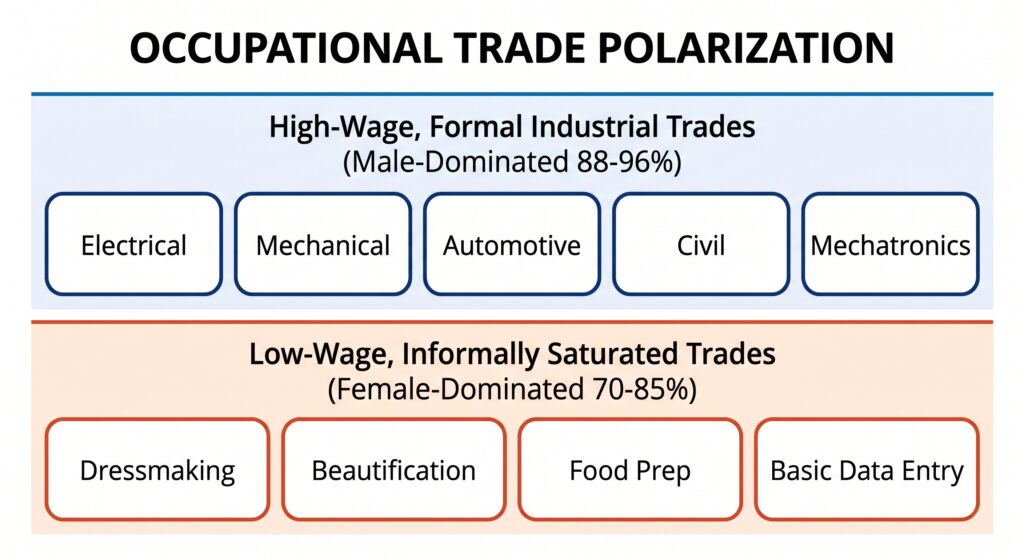
According to field findings presented in the ILO ProGRESS Project GESI Report, this trade segregation is reinforced by career counseling deficits. Vocational school administrators and admissions counselors routinely discourage female applicants from enrolling in heavy mechanical or electrical courses, citing unsubstantiated assumptions regarding female physical strength, employer reluctance to hire female technicians, or the lack of female instructors.
Institutional Culture, Pedagogy, and Faculty Representation
The institutional environment within TVET institutes frequently mirrors and reinforces broader societal biases. A critical structural issue is the profound underrepresentation of women in administrative leadership, technical instructional roles, and assessment panels. Across public polytechnics and Technical School and Colleges (TSCs), female instructors account for less than 15 percent of total teaching staff, with an even smaller fraction situated in core industrial workshops such as welding, foundry, or electronics. The absence of female role models in engineering disciplines signals to prospective female trainees that technical professions are masculine domains, compounding feelings of isolation and alienation among the few women who do enroll.
Pedagogical methods and curricular materials further reflect these structural shortcomings. Traditional Competency-Based Learning Materials (CBLMs) and textbooks have historically utilized gender-stereotyped visual imagery and text, depicting men as engineers, technicians, and supervisors, while portraying women exclusively as clients, garment operators, or food preparers. Furthermore, vocational instructors rarely receive formal pedagogy training on gender sensitivity, inclusive classroom management, or universal design for learning (UDL). Instruction is rarely differentiated to accommodate trainees with varying cognitive or sensory learning styles, leaving learners with developmental or sensory disabilities structurally excluded from effective workshop participation.
Campus Infrastructure, Safety, and Gender-Based Violence
Physical and environmental infrastructure represents one of the most immediate, tangible barriers to equitable participation. The vast majority of older public and private vocational campuses in Bangladesh were designed without basic considerations for gender-segregated physical amenities or universal accessibility. Key infrastructural deficits include:
-
Water, Sanitation, and Hygiene (WASH) Deficits: Numerous vocational schools lack dedicated, lockable, safe, and hygienic sanitary facilities for women. Inadequate menstrual hygiene management (MHM) infrastructure, including the absence of running water, disposal mechanisms for sanitary products, and clean privacy areas, contributes directly to high monthly absenteeism and eventual dropouts among female students.
-
Mobility and Architectural Barriers: Public technical institutes are predominantly multistory brick-and-mortar facilities devoid of elevators, entrance ramps, wide doorways, or tactile paving. Workshop machinery is rarely configured to accommodate wheelchair users or individuals with motor impairments, converting physical spaces into insurmountable structural barriers for persons with disabilities.
-
Safe Residential Accommodations and Transport: Because specialized polytechnics and TSCs are located in district headquarters or divisional hubs, rural students must travel significant distances. Public transport in Bangladesh is fraught with risks of sexual harassment, catcalling, and physical unsafety. The critical shortage of on-campus female student dormitories forces families to choose between insecure private boarding or withdrawing their daughters from education altogether.
-
Harassment and Institutional Redress Deficiencies: Sexual harassment and gender-based violence (GBV) remain pervasive concerns within workshops, transit routes, and industrial attachment sites. While the High Court Division of the Supreme Court of Bangladesh issued comprehensive directives in 2009 mandating the formation of Anti-Sexual Harassment Committees and transparent Grievance Redressal Mechanisms (GRMs) across all educational institutions, compliance in technical schools remains dismal. Committees are either unformed, inactive, or dominated by senior male faculty, instilling deep distrust among victims and ensuring that harassment incidents go almost entirely unreported.
School-to-Work Transition, Employer Perceptions, and Labor Market Realities
The ultimate efficacy of any vocational education system lies in its capacity to facilitate smooth, equitable, and sustainable transitions from training institutions into decent employment. For female and socially excluded TVET graduates in Bangladesh, the school-to-work transition represents an exceptionally fraught juncture characterized by labor market segmentation, persistent wage gaps, and entrenched employer bias.
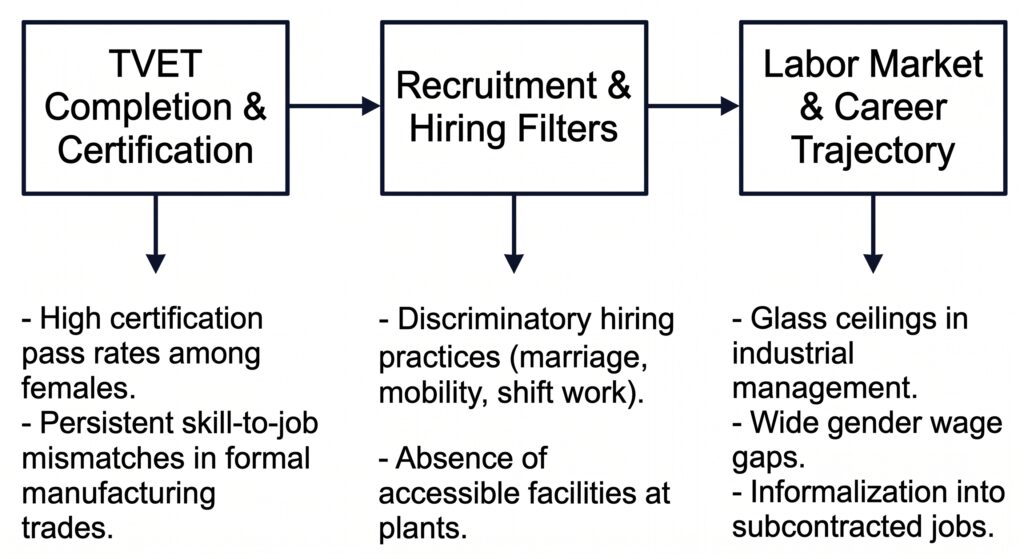
Employer recruitment behavior across key industrial sectors, including light engineering, electronics manufacturing, automotive servicing, construction, and information technology—continues to be governed by conventional gender assumptions. Manufacturing and construction employers routinely exhibit skepticism regarding the technical competence, physical stamina, and long-term reliability of female technicians. Corporate recruiters frequently avoid hiring young female polytechnic graduates under the assumption that they will exit the workforce upon marriage or childbearing, viewing them as high-risk investments compared to male peers.
Furthermore, industrial workplaces frequently lack basic accommodations necessary to support an inclusive workforce. Factories, automotive garages, and construction sites rarely provide separate female toilets, private lactation rooms, or reliable transportation for night-shift operations. Occupational health and safety (OHS) protocols are rarely adapted to diverse physical profiles; personal protective equipment (PPE) such as safety helmets, welding jackets, and boots are universally procured in standard male sizes, compromising both the safety and operational efficiency of female workers.
The structural institution of the mandatory industrial attachment a core requirement of the four-year Diploma in Engineering and NTVQF Level 3–4 certifications—illustrates these transition difficulties. During the final semester, students must complete several months of workplace-based training within private enterprises. Female trainees routinely struggle to secure attachments in core technical disciplines. Corporate firms routinely relegate female interns to clerical, administrative, or front-desk duties rather than machine operations, tool maintenance, or field site inspections, directly depriving them of practical, experiential technical learning.
For persons with disabilities, the school-to-work bridge is almost completely fractured. Employer hesitation is compounded by superstitious misconceptions regarding disability, unwarranted fears of industrial liability, and an unwillingness to invest in low-cost reasonable workplace accommodations. Consequently, the labor market return on vocational certification for a person with a disability is substantially lower than that for an able-bodied peer, forcing many certified disabled individuals back into begging, informal petty trade, or complete dependency on family safety nets.
Similarly, post-training self-employment pathways for marginalized graduates face capital market bottlenecks. While microcredit is ubiquitous across rural Bangladesh, it is characterized by high interest rates, short repayment grace periods, and small initial disbursement sizes that are unsuited for capital-intensive technical enterprises (such as setting up an electrical repair workshop, welding fabrication unit, or computer diagnostic center). Formal commercial banks impose prohibitive collateral requirements, stringent documentation standards, and gender-biased credit assessments, effectively locking out young female, disabled, and indigenous entrepreneurs who lack land titles or family assets.
The ILO TVET Reform and ProGRESS Frameworks
The International Labour Organization has maintained an enduring technical partnership with the Government of Bangladesh, initiating large-scale vocational restructuring through the European Union-funded TVET Reform Project (2007–2015), the Bangladesh Skills for Employment and Productivity (B-SEP) Project (funded by the Government of Canada), and currently the Promoting Gender-Responsive Enterprise Development and TVET Systems (ProGRESS) project.
The ProGRESS initiative has established a comprehensive blueprint for systemic GESI mainstreaming by simultaneously targeting policy frameworks, institutional capacity, and ground-level training delivery. ProGRESS works directly with the Directorate of Technical Education, BTEB, and enterprise partners to operationalize gender-responsive budgeting, review NTVQF learning materials for gender and social bias, and build institutional capacity across public Technical Training Centres (TTCs) and polytechnics. Crucially, the project has pioneered targeted advocacy campaigns designed to dismantle community stereotypes surrounding non-traditional trades, successfully facilitating cohorts of female trainees into electrical installation, welding, and green technologies.
World Bank and Multilateral Capital Initiatives: ASSET and EARN
Multilateral development banks have financed expansive capital investments aimed at scaling TVET access and modernization. The World Bank’s Accelerating and Strengthening Skills for Economic Transformation (ASSET) Project, jointly supported by the Government of Bangladesh, represents an extensive initiative targeting modern polytechnic education, curriculum modernization, and institutional governance. ASSET explicitly embeds GESI conditionality into its institutional grant disbursement mechanisms. Participating polytechnics are incentivized through performance-based funding to increase female enrollment in engineering diplomas, upgrade female WASH facilities, institute active sexual harassment complaint cells, and provide market-aligned stipends to disadvantaged students.
Operating concurrently under the Ministry of Youth and Sports and the Department of Youth Development (DYD), the World Bank-supported Economic Acceleration and Resilience for NEET Project (EARN) targets approximately 900,000 disadvantaged rural and peri-urban youth who are entirely disengaged from learning and employment. Recognizing the acute gender dimension of the NEET population, the project mandates that at least 60 percent of all direct beneficiaries must be young women. EARN combines basic vocational literacy, soft-skills training, enterprise development training, and competitive seed financing, bypassing conventional institutional barriers by establishing local Upazila Youth Training Centers and partnering with community-based organizations.
Non-Governmental Innovations: BRAC and UCEP Models
Complementing public and multilateral interventions, civil society organizations in Bangladesh have generated highly successful localized delivery models. BRAC’s Skills Training for Advancing Resources (STAR) program has pioneered the modern apprenticeship model within the informal sector. Rather than requiring marginalized youth to enroll in formal brick-and-mortar institutes, STAR identifies experienced informal master craftspersons, sensitizes them to gender equality and disability inclusion, and pairs them with underprivileged youth, predominantly out-of-school adolescent girls and persons with disabilities, for six months of hands-on workplace training complemented by weekly theoretical instruction.
The STAR model achieves post-training employment rates exceeding 95 percent, at a fraction of the per-capita cost of formal technical education, by deeply grounding training in existing market relationships and providing direct mentorship within local communities. Similarly, the Underprivileged Children’s Educational Programs (UCEP) Bangladesh operates integrated general and vocational schools across urban industrial belts, maintaining strict gender parity targets, providing accessible physical facilities for disabled youth, and operating dedicated job-placement cells that liaise directly with private manufacturing firms to ensure fair-wage employment for graduates.
| Initiative / Program | Implementing / Funding Agency | Target Demographic | Core GESI Intervention Strategy | Documented Impact / Outcomes |
| ProGRESS Project | ILO / Government of Canada / DTE | Female trainees, rural marginalized groups, institutional trainers. | Institutional GESI capacity building; revision of CBLMs; non-traditional trade promotion; industry linkages. | Catalyzed policy integration of GESI guidelines across DTE; increased female enrollment in non-traditional trades. |
| ASSET Project | World Bank / DTE / TMED | Polytechnic students, formal TVET institutions, disadvantaged youth. | Performance grants tied to female enrollment; infrastructural upgrades (WASH); targeted student stipends. | Financed modernization of sanitation and laboratory facilities across public polytechnics nationwide. |
| EARN Project | World Bank / Department of Youth Development | 900,000 rural youth; minimum 60% young women. | Upazila-level outreach; soft skills; second-chance vocational education; seed funding for micro-enterprises. | Mobilized vulnerable rural female NEET populations into structured training and livelihood pipelines. |
| STAR Program | BRAC | Ultra-poor youth, adolescent dropouts, persons with disabilities. | 6-month dual informal apprenticeship with master craftspersons; soft skills; financial literacy; OHS gear. | Achieved >95% employment rates; over 50% female participation, with substantial entry into non-traditional trades. |
| UCEP Skills Delivery | UCEP Bangladesh / Multi-donor | Urban working children, impoverished youth, PWDs. | Integrated market-driven vocational training; free assistive transport; dedicated private employer placement. | Consistent 90%+ job placement; established high employer satisfaction benchmarks for female technical graduates. |
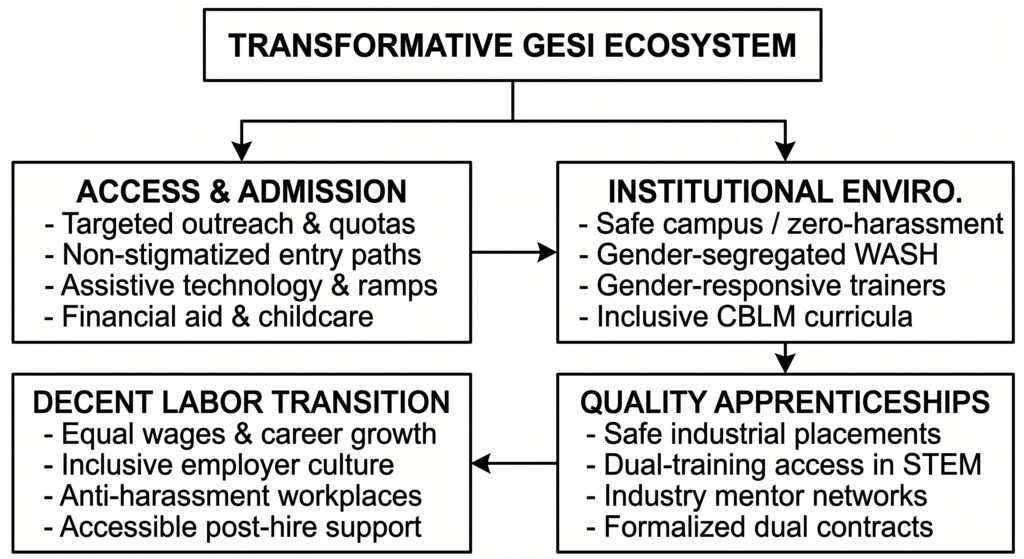
Strategic Framework for Transformative GESI in TVET
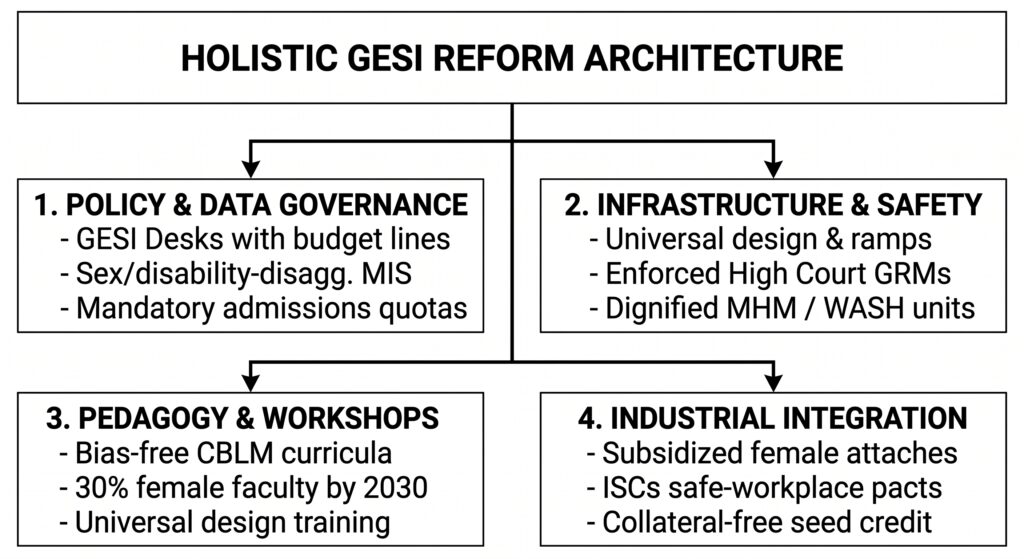
To transcend fragmented pilot initiatives and establish a truly equitable, resilient, and market-responsive technical education ecosystem, Bangladesh requires an integrated, institutionalized strategic framework. This framework must align high-level policy formulation with institutional governance, infrastructure investments, pedagogical transformation, and private sector accountability.
Institutional Governance, Budgetary Allocation, and Data Systems
Transformative reform begins with restructuring institutional accountability across the TVET governance apparatus. The Directorate of Technical Education (DTE), Bangladesh Technical Education Board (BTEB), and National Skills Development Authority (NSDA) must establish fully staffed, operational GESI Units with institutional mandates that extend beyond advisory functions. These units must be endowed with dedicated budget lines under the national Medium Term Budgetary Framework (MTBF) to ensure financial sustainability independent of external donor financing cycles.
Simultaneously, the national TVET Management Information System (TVET-MIS) must be systematically upgraded to mandate the collection, analysis, and reporting of disaggregated data. Administrative datasets must capture student enrollment, attendance, trade selection, dropout rates, certification pass percentages, industrial attachment completion, and post-graduation employment verified at 6- and 12-month intervals, strictly disaggregated by gender, disability status, ethnic identity, and geographic origin. Transparent data systems create institutional visibility, enabling policymakers to hold institutional heads accountable for underutilized quotas and high female attrition rates.
Infrastructure Universalization and Anti-Harassment Compliance
National capital budgets must prioritize the universal retrofitting of all existing public polytechnics, Technical School and Colleges (TSCs), and Technical Training Centres (TTCs), while enforcing strict accessibility standards for all future construction.
-
Universal Physical Accessibility: Campus buildings, laboratories, and outdoor testing facilities must be equipped with wheelchair ramps compliant with international incline standards, tactile guide paths for visually impaired learners, accessible ground-floor restrooms, wide doorways, and adjustable workshop benches.
-
Comprehensive WASH and Menstrual Hygiene Management: Technical institutes must provide dedicated, secure, well-lit female restrooms equipped with continuous running water, disposal units for menstrual hygiene products, and private rest spaces, ensuring that female trainees can manage their reproductive health with dignity without disrupting their educational continuity.
-
Institutionalization of Anti-Harassment Mechanisms: Enforcing the 2009 Supreme Court directives regarding sexual harassment must be linked directly to institutional accreditation and state subventions. Every technical institute must establish an active, autonomous Anti-Sexual Harassment Committee, comprised of at least 50 percent female members and featuring external civil society representation. Institutes must deploy multi-channel, anonymous grievance mechanisms (including digital reporting portals and physical complaint boxes) and conduct mandatory orientation sessions at the start of each academic term to educate students and faculty on sexual harassment policies, consent, and reporting pathways.
Curricular, Pedagogical, and Faculty Modernization
Curricular transformation must address both the explicit and hidden curricula within technical classrooms. BTEB and NSDA must undertake a comprehensive, systematic gender and inclusivity audit of all existing Competency-Based Learning Materials (CBLMs) across all NTVQF levels. Instructional texts, case studies, and graphical illustrations must be revised to intentionally feature female technicians, individuals with disabilities, and indigenous professionals thriving across non-traditional industrial and STEM occupations.
Concurrently, a national initiative must be launched to reform the Training of Trainers (ToT) curriculum administered by the Technical Teachers Training College (TTTC) and Vocational Teachers Training Institute (VTTI). Completion of standardized modules on gender sensitivity, inclusive pedagogical communication, and disability accommodations must be instituted as a mandatory prerequisite for teacher certification, tenure, and promotion. Furthermore, the Ministry of Education must institute affirmative action recruitment drives to achieve a targeted minimum threshold of 30 percent female instructional and leadership staff across all public TVET institutions by 2030, actively mentoring female diploma holders into vocational teaching careers.
Targeted Demand-Side Financing and Community Engagement
Recognizing that indirect financial costs, such as transportation, specialized tools, uniforms, and foregone household wages ,represent a severe impediment for impoverished families, the government must modernize demand-side financing mechanisms.
-
Targeted Non-Traditional Trade Stipends: Financial stipends should be dynamically calibrated to incentivize female enrollment in non-traditional, high-wage trades (such as advanced manufacturing, industrial electrical, and computing). Female trainees entering these fields should receive higher living stipends, full tuition waivers, and free toolkits upon graduation.
-
Childcare and Safe Mobility Solutions: Major polytechnics and urban vocational centers must pilot on-campus, subsidized childcare facilities, enabling young mothers to pursue technical credentials without compromising child welfare. In parallel, local administrative authorities must collaborate with public transport operators to provide subsidized, safe student shuttle services connecting peripheral rural settlements with central technical campuses.
-
Community Mindset Transformation: Sustained community-level communication campaigns must be deployed across digital media, local radio, and religious and community institutions to dismantle gendered myths regarding technical labor. Showcasing real-world success stories of female mechanical engineers, disabled graphic designers, and minority tech entrepreneurs establishes powerful counter-narratives that alter community perceptions and build parental support.
Industrial Integration, Safe Attachments, and Inclusive Entrepreneurship
Bridging the school-to-work chasm requires forging formalized, institutionalized partnerships with the private sector through the network of Industry Skills Councils (ISCs) across diverse economic sectors.
DTE and polytechnic administrations must establish formal Memorandums of Understanding (MoUs) with private industrial federations (such as the Bangladesh Garment Manufacturers and Exporters Association – BGMEA, Bangladesh Engineering Industry Owners Association – BEIOA, and Bangladesh Computer Samity – BCS) to regulate the industrial attachment ecosystem. These agreements must legally bind participating enterprises to provide safe, non-discriminatory, and zero-harassment workplace environments, backed by regular spot inspections by labor inspectors and institutional placement officers. Enterprises that successfully train and hire female and disabled technical interns should be rewarded through fiscal incentives, such as tax credits on internship training expenditures and preferential scoring in public procurement contracts.
Finally, for graduates pursuing entrepreneurial ventures, the government ,in collaboration with the Bangladesh Bank and specialized micro-enterprise development funds—should establish a dedicated, low-interest, collateral-free credit window. Coupled with post-training business incubation, legal registration assistance, and digital market linkage support, this financial pipeline will ensure that marginalized vocational graduates can successfully establish and scale productive, sustainable technical enterprises.
Policy Synthesis and Long-Term Implications
The structural transformation of Technical and Vocational Education and Training in Bangladesh through the deliberate, uncompromising integration of Gender Equality and Social Inclusion principles represents a foundational test of the country’s development maturity. As Bangladesh prepares for its formal graduation from Least Developed Country status and navigates the multifaceted disruptions of global automation, economic diversification cannot be achieved while systematically sidelining half its population and discarding its most vulnerable citizens.
The empirical evidence demonstrates that while progressive policy frameworks exist on paper, their transformative potential remains constrained by deeply rooted sociocultural norms, institutional under-resourcing, physical infrastructure deficits, and labor market discrimination. Dismantling these systemic bottlenecks demands moving decisively beyond cosmetic quotas toward a coordinated, cross-sectoral agenda that couples rigorous infrastructure universalization and pedagogical reform with robust industrial accountability and targeted social financing.
Investing in an inclusive vocational ecosystem generates extraordinary developmental dividends. Equipping women, persons with disabilities, and marginalized youth with market-demanded, forward-looking technical capabilities unleashes latent economic productivity, drives down structural youth NEET rates, and elevates female labor force participation. More fundamentally, it shifts the national development paradigm from an economic growth model dependent on low-wage vulnerability to one anchored in human dignity, social equity, and technological competence. The strategic choices and institutional investments made in the TVET sector over the coming decade will determine whether Bangladesh’s demographic dividend emerges as a driver of shared prosperity or as a missed developmental opportunity.
References
-
Bangladesh Directorate of Technical Education (DTE). (2024). TVET Annual Sector Performance Report (ASPR) 2024. Ministry of Education, Government of the People’s Republic of Bangladesh. TVET Annual Sector Performance Report.
-
Bangladesh Ministry of Youth and Sports. (2024). Economic Acceleration and Resilience for NEET Project (EARN): Environmental and Social Management Framework. Department of Youth Development, Government of the People’s Republic of Bangladesh. EARN Project Assessment.
-
International Labour Organization (ILO). (2025). Assessment of Gender Equality and Social Inclusion Gaps in the Skills and TVET Sector of Bangladesh. Promoting Gender-Responsive Enterprise Development and TVET Systems (ProGRESS) Project, ILO Country Office for Bangladesh. Assessment of GESI Gaps in Skills and TVET.
-
International Labour Organization (ILO). (2025). Assessment of Gender Equality and Social Inclusion Gaps in the Skills and TVET Sector of Bangladesh (Draft Final Report). ProGRESS Project, ILO Dhaka. ILO ProGRESS Project GESI Report.
-
International Labour Organization (ILO). (2020). Situation Analysis of Bangladesh TVET Sector: A Background Work for the TVET SWAp. ILO Country Office for Bangladesh. Situation Analysis of Bangladesh TVET Sector.
-
International Labour Organization (ILO). (2014). TVET Reform: Gender Mainstreaming into Technical and Vocational Education and Training (TVET) in Bangladesh. ILO Country Office for Bangladesh. Gender Mainstreaming into TVET.
-
World Bank. (2017). Bangladesh: Female Participation in Technical and Vocational Education and Training (TVET). Education Global Practice, South Asia Region. World Bank Group. World Bank Female Participation in TVET.
-
World Bank. (2021). Accelerating and Strengthening Skills for Economic Transformation (ASSET) Project Appraisal Document. World Bank Group. World Bank ASSET Project Information.