
Introduction, The Paradigm Shift in Bangladeshi Migration
For decades, Bangladesh has been globally recognized as a powerhouse for manpower export. Millions of our citizens have crossed borders to build infrastructure, drive economic growth, and send back crucial remittances that sustain our national economy. Our probashi workers are the backbone of our foreign exchange reserves. However, the global landscape of employment is undergoing a rapid and irreversible transformation. The era of mass, low-skilled labor migration is gradually closing, making way for a highly competitive, demand-driven era of skill migration.
As an expert deeply embedded in the Technical and Vocational Education and Training (TVET) sector, I have witnessed firsthand the urgency of transitioning our workforce from generic laborers to certified, globally recognized professionals. This article provides an exhaustive exploration of skill migration in our local context. It dissects the differences between general and skilled migration, explores the diverse pathways available to our workforce, and examines both international and internal mobility.
General Migration Versus Skill Migration, Decoding the Difference
To establish a robust migration strategy, we must first delineate the fundamental differences between general migration and targeted skill migration. General migration encompasses a broad spectrum of human movement driven by various factors, such as family reunification, asylum seeking, or the pursuit of generic economic opportunities. Historically, a significant portion of Bangladeshi migrant workers fell into this category, traveling on general work visas to fulfill essential but low-tier roles in construction, domestic work, and agriculture abroad.
Skill migration, conversely, is an entirely different architecture of mobility. It is precision-engineered to address specific labor market intelligence and industry demand in the destination country. Skilled migration occurs when individuals relocate specifically because their technical competencies, vocational training, or professional qualifications perfectly match recognized shortages. These individuals do not migrate merely to find work, they migrate because a specific sector requires their verified expertise.
The economic implications of this shift are profound. A skilled migrant commands a significantly higher wage, enjoys better working conditions, and benefits from stronger legal protections. From a macroeconomic perspective, the remittances generated by skilled migrants are exponentially larger and more stable. More importantly, skilled migrants engage in “brain circulation”, acquiring advanced industrial knowledge abroad that can eventually be transferred back to the local economy.
The Architecture of Domestic Skill Migration Pathways
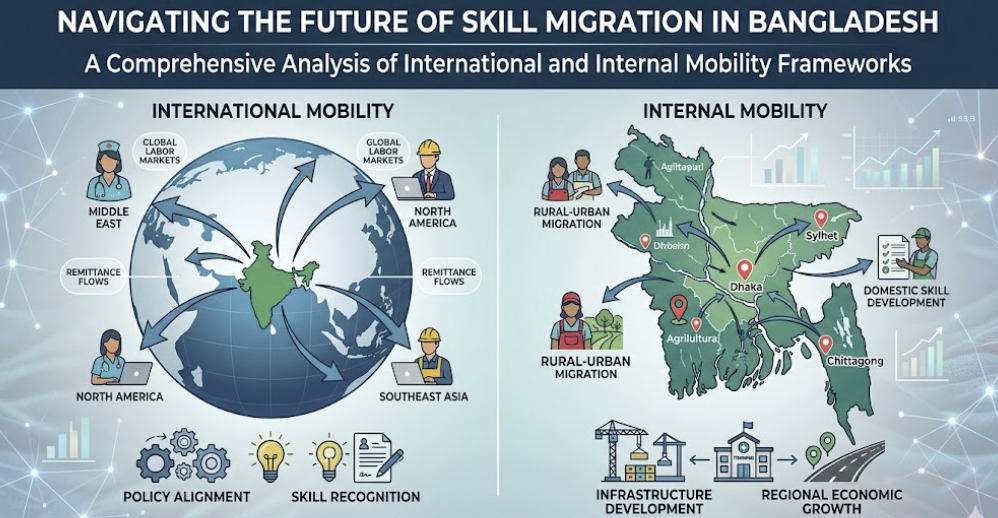
Domestic skill migration is not a monolithic concept. Just like international mobility, the internal movement of our workforce from rural areas to industrial hubs is categorized into several distinct pathways, each requiring a tailored approach to training and national certification.
- Government-Led Mega Projects and Economic Zones: In our local context, large-scale infrastructure projects and Special Economic Zones (SEZs) remain the most structured pathways for mass internal skill migration. Instead of bilateral international agreements, this movement is driven by national development goals managed by authorities like BEZA. Workers are recruited from across the country, assessed, and placed in high-priority zones like Matarbari or Mirsarai. These national initiatives are evolving to demand higher technical proficiencies, requiring our regional Technical Training Centers (TTCs) to rigorously align their curricula with the exact occupational standards needed for these domestic mega-projects.
- Merit-Based Corporate Recruitment: Major national conglomerates operate on highly competitive, merit-based systems designed to build their long-term human capital. Candidates from rural areas are evaluated against standardized matrices that prioritize NTVQF certifications, technical diplomas, and relevant practical experience. For a skilled professional from a smaller upazila to succeed in securing a role at a high-tech park in Gazipur or a manufacturing hub in Dhaka, their NTVQF qualifications must be nationally portable and universally recognized by domestic industry leaders.
- Direct Industrial Recruitment: This is a highly direct, demand-driven model. An industrial employer in a major hub like Chattogram or Narayanganj identifies a specific skills gap, perhaps in RMG machine maintenance or specialized welding, and recruits a trained worker from a rural district who possesses the exact competencies required. To capitalize on this internal mobility, our regional training institutions must foster closer ties with local industry councils and factory owners to anticipate these niche, district-level demands.
- Seasonal and Project-Based Circular Migration: Many urban centers and agricultural hubs experience cyclical labor demands, creating targeted opportunities for temporary internal movement. Seasonal or project-based circular migration allows workers to move from their gram to the shohor for defined periods, such as short-term urban construction cycles or agro-processing seasons. This model is highly beneficial as it promotes regular cash flow back to rural communities while ensuring the worker eventually returns, allowing their home district to benefit from their newly acquired practical experience without causing permanent urban overcrowding.
The Architecture of International Skill Migration Pathways
International skill migration is not a monolithic concept. It is categorized into several distinct pathways, each requiring a tailored approach to training and certification.
-
Government-to-Government (G2G) Agreements: In our context, G2G agreements remain one of the most structured and secure pathways for large-scale skill migration. These are bilateral agreements established directly between the government and receiving nations. Through state agencies like the Bureau of Manpower Employment and Training (BMET), workers are recruited, assessed, and placed in specific sectors. G2G pathways are evolving to demand higher technical proficiencies, requiring our Technical Training Centers (TTCs) to rigorously align their curricula with the exact occupational standards dictated by partner countries like Japan or South Korea.
-
Points-Based Independent Migration: Nations such as Canada, Australia, and New Zealand operate on points-based systems designed to build long-term human capital. Candidates are evaluated against a standardized scoring matrix that awards points for age, language proficiency, and recognized TVET qualifications or academic degrees. For a Bangladeshi professional to succeed here, their qualifications must be highly portable.
-
Employer-Sponsored Migration: This is a highly direct, demand-driven model. An overseas employer identifies a specific skills gap, perhaps in advanced manufacturing or specialized healthcare, and sponsors a foreign worker who possesses the exact competencies required. To capitalize on this, our training institutions must foster closer ties with international industry councils to anticipate these niche demands.
-
Temporary Circular Migration: Many destination countries create targeted visa streams for industries facing critical, immediate shortages. Temporary or circular migration allows workers to move for defined periods. This model is highly beneficial as it promotes regular remittance flows while ensuring the worker eventually returns, allowing the country to benefit from their newly acquired international experience.
The Bedrock of Mobility, TVET and Competency-Based Training (CBT&A)
The entire structure of skill migration rests upon the foundation of Technical and Vocational Education and Training. However, traditional, time-based education models are no longer sufficient. The modern labor market demands absolute certainty of a worker’s abilities. This is where Competency-Based Training and Assessment (CBT&A) methodologies become the central pillar of our migration strategy.
As an expert who has spent years developing unit of competency frameworks, I advocate for CBT&A because it shifts the focus from what was taught to what the learner can actually do. In a CBT&A framework, training is modular, specific, and directly mapped to National Occupational Standards. A trainee does not simply pass a written exam, they must physically demonstrate their ability to perform a specific task under industry conditions to the satisfaction of a certified assessor.
This methodology is critical for migration because it provides international employers with a guarantee. When a worker arrives with a CBT&A certification, the employer knows exactly what technical skills that worker possesses, eliminating the risk and uncertainty typically associated with international hiring.
Navigating Skills Portability and NQF
Having the skills is only half the battle, proving those skills internationally is the other. Skills portability is the concept that a qualification earned locally holds equal weight and recognition in a destination country. This portability is governed by National Technical and Vocational Qualifications Frameworks (NTVQF).
For skill migration to flow seamlessly, our NTVQF must be benchmarked against regional and global frameworks. This involves rigorous curriculum mapping, a process I have extensively managed throughout my career. When our framework aligns with international standards, it paves the way for Mutual Recognition Agreements (MRAs). MRAs are diplomatic and educational treaties where two countries agree to recognize each other’s TVET certifications. Strengthening these agreements is the most critical policy objective for enhancing the outward mobility of our skilled workforce.
Future-Proofing the Workforce, Green TVET
The global economy is undergoing a massive shift towards sustainability, creating an unprecedented demand for green skills. To maintain a competitive edge in the global labor market, we must aggressively pivot towards Green TVET. This involves integrating environmental resource management, carbon footprint reduction, and sustainable practices into every level of our vocational training.
My tenure as the National Team Leader for the Ernst & Young and GIZ Skill4SE project has heavily focused on this transition. We are pioneering the development of renewable energy competency modules, specifically targeting solar and wind energy installation, maintenance, and grid integration. Skilled migration in the next decade will be dominated by technicians who can build and maintain the green infrastructure of the future.
Strategic Policy Recommendations for the Next Decade
To fully capitalize on the global shift towards skill migration, we must implement targeted, forward-thinking policies:
-
Accelerate Mutual Recognition Agreements: The government must prioritize diplomatic efforts to establish MRAs with emerging labor markets in Eastern Europe, East Asia, and the renewable energy sectors of the Middle East.
-
Mandate Green TVET Modules: Core sustainability and resource management competencies must be integrated into all national curricula, regardless of the specific trade.
-
Expand the Launchpad Network: Establish dedicated career and migration counseling hubs in every district to provide transparent, data-driven advice to potential skilled migrants.
-
Invest in Digital Assessor Capacity: Scale the capabilities of digital platforms to handle the massive volume of theoretical assessments and continuous professional development required for a modern workforce.
-
Elevate the Status of TVET: Continue national campaigns to shift the cultural perception of vocational training from a second choice to a premier pathway for international career success.
Conclusion
The trajectory of our economic future is deeply intertwined with our ability to adapt to the changing realities of global labor mobility. The days of relying on the export of unskilled manpower are fading. In its place is a highly structured, fiercely competitive market for specialized competencies. By fully embracing Competency-Based Training and Assessment, aggressively mapping our qualifications to international standards, and pioneering emerging fields like Green TVET, we can transform our demographic dividend into a globally recognized force of skilled professionals. Skill migration is not just a mechanism for individual prosperity, it is the strategic blueprint for sustained economic elevation.